
Electric flux is a core concept in electromagnetism, essential for analyzing electric fields and charge distributions. It represents the total number of electric field lines passing through a surface and is crucial in understanding Gauss’s Law.
For students preparing for NEET, IIT-JEE, and NDA, mastering electric flux will provide deeper insights into electrostatics and help solve complex problems efficiently.
Electric Flux Definition?
Electric flux ((\Phi_E)) measures the flow of an electric field through a surface. It helps visualize how electric fields interact with physical boundaries and determine charge effects.
Mathematically,

Where:
- (E) = Electric field intensity (N/C or V/m)
- (A) = Area of the surface (m²)
- (\theta) = Angle between the field and surface normal
Conceptual Understanding Through a Real-World Analogy
Think of sunlight passing through a window:
- If sunlight falls perpendicular to the window, maximum light enters.
- If sunlight falls at an angle, less light gets through.
- If the window is completely blocked, no light enters.
Similarly, the electric flux depends on how an electric field interacts with the surface it crosses.
Key Properties of Electric Flux
- Dependent on the Field Strength – Stronger electric fields result in higher flux.
- Influenced by Surface Orientation – Perpendicular placement maximizes flux, while tilted surfaces reduce it.
- Closed Surface Concept – Net electric flux through a closed surface determines the total charge inside.
Gauss’s Law and Its Connection with Electric Flux
Gauss’s Law states that the total electric flux through a closed surface is directly proportional to the enclosed charge:

Where:
- (Q) = Net charge enclosed (C)
- (\varepsilon_0) = Permittivity of free space ((8.854 \times 10^{-12} F/m))
This law simplifies calculations related to electric fields of symmetric charge distributions, making it a powerful tool in electrostatics.
Applications of Electric Flux in Physics
- Understanding Charge Distributions – Essential for calculating electric fields in various systems.
- Capacitor Design – Helps in structuring effective charge storage mechanisms.
- Electrical Engineering – Used in insulation technologies and electrostatic applications.
Conclusion
Electric flux is a critical concept that strengthens a student’s grasp of electrostatics, providing clarity on charge behavior and field interactions. Mastering this principle at Convex Classes Jaipur will help students excel in competitive exams like NEET, IIT-JEE, and NDA through a structured approach to learning electromagnetism.
important questions of electric flux
Example 1: Electric Flux Through a Flat Surface?

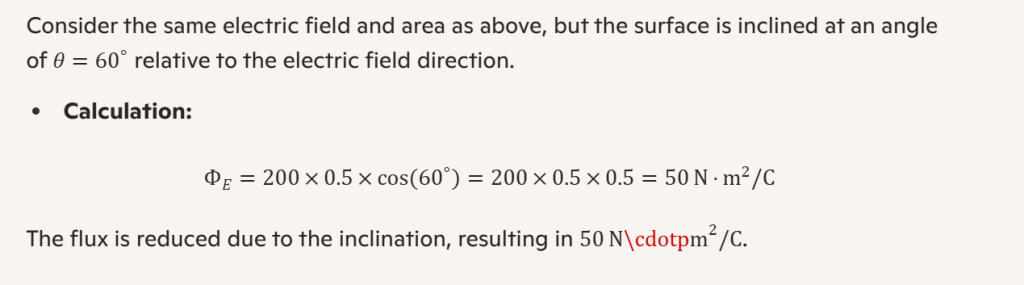
Example 2: Electric Flux Through a Inclined Surface?
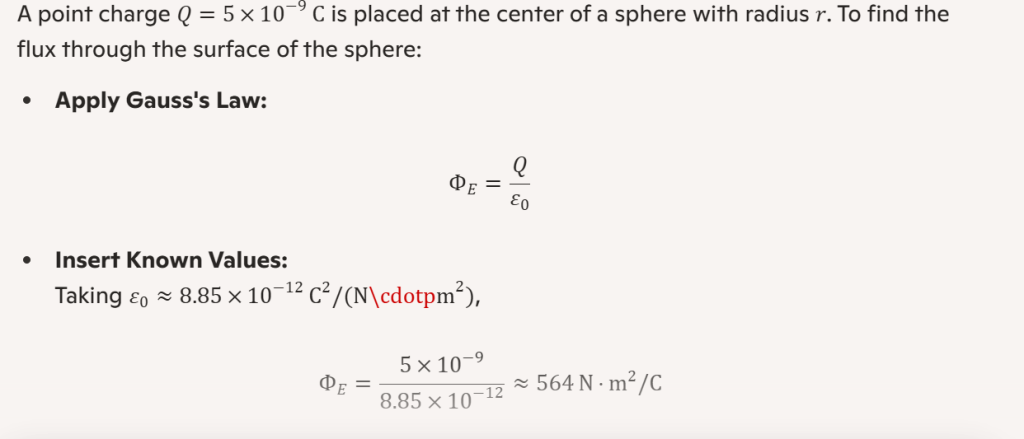
Example 3: Using Gauss’s Law for a Spherical Surface?
FAQs About Electric Flux
Below are some frequently asked questions that encapsulate the essence of electric flux and help clear common doubts.
Q1: What is the physical significance of electric flux?
A: Electric flux represents the number of electric field lines passing through a surface. It quantifies the influence of an electric field over an area, which is fundamental in understanding how charge distributions affect the surrounding space.
Q2: How does the angle between the electric field and the surface affect the flux?

Q3: Can electric flux be negative?
A: Yes, electric flux can be negative. The sign indicates the direction of the electric field relative to the surface’s orientation. A negative flux signifies that the net electric field is entering the surface, while a positive flux indicates it is leaving the surface.
Q4: How does Gauss’s law relate to electric flux?
A: Gauss’s law states that the net electric flux through a closed surface is equal to the charge enclosed divided by the permittivity of free space, ε0. This fundamental relationship is used to calculate electric fields in symmetrical charge distributions.
Q5: What are some common mistakes when calculating electric flux?
A: Common errors include not accounting for the angle between the electric field and the surface, misidentifying the area vector’s direction, and applying Gauss’s law to non-closed surfaces without proper adjustments.