Pair of Linear Equations in Two Variables is one of the highest-weightage chapters in Class 10 Maths — almost every board paper has at least one word problem and one method-based question (substitution, elimination, or cross-multiplication) from this chapter. Students often lose marks not because they don’t know the method, but because they frame the equations incorrectly from the word problem.
At Convex Classes Jaipur, we focus heavily on this “translation skill” — converting a real-life situation into two correct linear equations — because once the equations are framed correctly, solving them is usually straightforward. Below is a complete, in-depth walkthrough of the chapter’s theory along with fully solved NCERT Exercise 3.1 questions.
Chat with Convex Classes Jaipur Get Class 10 Maths batch details on WhatsApp Chat Now →What Is a Pair of Linear Equations in Two Variables? (Concept Overview)
A linear equation in two variables is an equation of the form:
ax + by + c = 0
where a, b, c are real numbers, and a and b are not both zero. Every such equation, when plotted on a graph, represents a straight line.
When we have two such equations together, involving the same two variables, we call it a pair of linear equations in two variables:
a₁x + b₁y + c₁ = 0 a₂x + b₂y + c₂ = 0
Since each equation represents a straight line, a pair of such equations represents two lines on the same graph. Solving the pair means finding the point(s) — that is, the value(s) of x and y — that satisfy both equations simultaneously. Geometrically, this is simply the point of intersection of the two lines.
Why This Chapter Matters
This chapter appears in board exams in two major forms:
- Word problems — converting real-world situations (ages, cost of items, speed-distance-time, etc.) into a pair of linear equations, then solving them.
- Direct algebraic problems — solving a given pair of equations using substitution, elimination, or cross-multiplication.
The Three Possible Cases: Consistency of a Pair of Linear Equations
Given the standard pair:
a₁x + b₁y + c₁ = 0 a₂x + b₂y + c₂ = 0
There are exactly three possible outcomes, based on comparing the ratios of the coefficients:
| Condition | Nature of System | Graphical Meaning | Number of Solutions |
|---|---|---|---|
| a₁/a₂ ≠ b₁/b₂ | Consistent (independent) | Lines intersect at exactly one point | Unique solution |
| a₁/a₂ = b₁/b₂ = c₁/c₂ | Dependent (consistent) | Lines coincide (same line) | Infinitely many solutions |
| a₁/a₂ = b₁/b₂ ≠ c₁/c₂ | Inconsistent | Lines are parallel, never meet | No solution |
Exam tip (Convex Classes Jaipur): This table is one of the most frequently asked concepts — CBSE loves asking “for what value of k will the given pair of equations have no solution / infinitely many solutions / a unique solution.” Always set up the three ratios first before applying the condition.
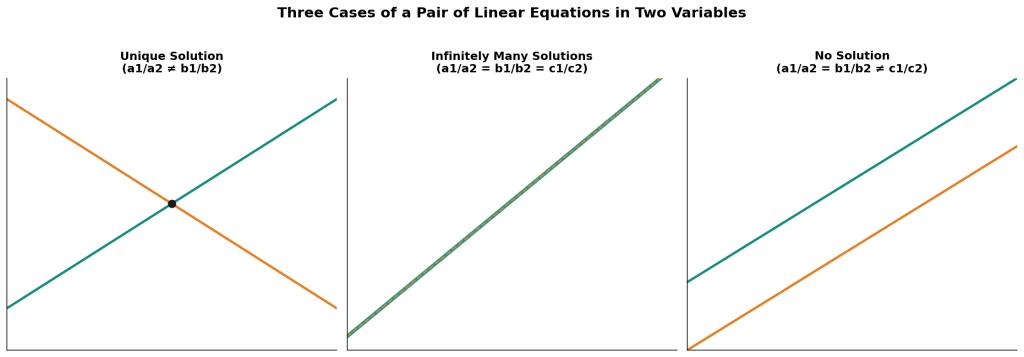
The chart above shows how the three cases look graphically: intersecting lines (unique solution), coincident lines (infinite solutions), and parallel lines (no solution).
Methods of Solving a Pair of Linear Equations
1. Graphical Method
Plot both equations on the same graph by finding at least two solutions (points) for each equation, then draw the corresponding lines. The point where the two lines intersect gives the solution. This method is intuitive but less accurate when the solution involves non-integer (fractional/decimal) values, since reading exact coordinates off a graph is difficult.
2. Algebraic Methods
These are more precise, especially for non-integer solutions. There are three main algebraic methods:
(a) Substitution Method
- Express one variable in terms of the other from one equation.
- Substitute this expression into the second equation to get an equation in a single variable.
- Solve for that variable, then substitute back to find the other variable.
(b) Elimination Method
- Multiply one or both equations by suitable constants so that the coefficients of one variable become numerically equal.
- Add or subtract the equations to eliminate that variable, leaving an equation in a single variable.
- Solve for this variable, then substitute back into either original equation.
(c) Cross-Multiplication Method For the pair: a₁x + b₁y + c₁ = 0 a₂x + b₂y + c₂ = 0
The solution is given directly by:
x / (b₁c₂ − b₂c₁) = y / (c₁a₂ − c₂a₁) = 1 / (a₁b₂ − a₂b₁)
provided a₁b₂ − a₂b₁ ≠ 0. This method is extremely fast once the formula is memorised correctly and is especially useful in objective-type or time-constrained questions.
Equations Reducible to a Pair of Linear Equations
Sometimes the given equations are not linear in their original form (e.g., they contain terms like 1/x or 1/y). In such cases, a substitution — commonly p = 1/x and q = 1/y — reduces them to a standard pair of linear equations in p and q, which can then be solved using any of the methods above, followed by converting back to find x and y.
NCERT Exercise 3.1 — Fully Solved Questions
Q1. Aftab tells his daughter, “Seven years ago, I was seven times as old as you were then. Also, three years from now, I shall be three times as old as you will be.” Represent this situation algebraically and graphically.
Solution:
Let Aftab’s present age = x years, and his daughter’s present age = y years.
Condition 1 — Seven years ago: Aftab’s age then = (x − 7); Daughter’s age then = (y − 7)
According to the condition: x − 7 = 7(y − 7) x − 7 = 7y − 49 x − 7y + 42 = 0 … (Equation 1)
Condition 2 — Three years from now: Aftab’s age then = (x + 3); Daughter’s age then = (y + 3)
According to the condition: x + 3 = 3(y + 3) x + 3 = 3y + 9 x − 3y − 6 = 0 … (Equation 2)
Graphical Representation:
For Equation 1 (x − 7y + 42 = 0, i.e., x = 7y − 42):
| y | 5 | 6 | 7 |
|---|---|---|---|
| x | −7 | 0 | 7 |
For Equation 2 (x − 3y − 6 = 0, i.e., x = 3y + 6):
| y | 0 | −2 | 2 |
|---|---|---|---|
| x | 6 | 0 | 12 |
Plotting these points and drawing both lines, they intersect at the point (42, 12) — meaning Aftab’s present age is 42 years and his daughter’s present age is 12 years.
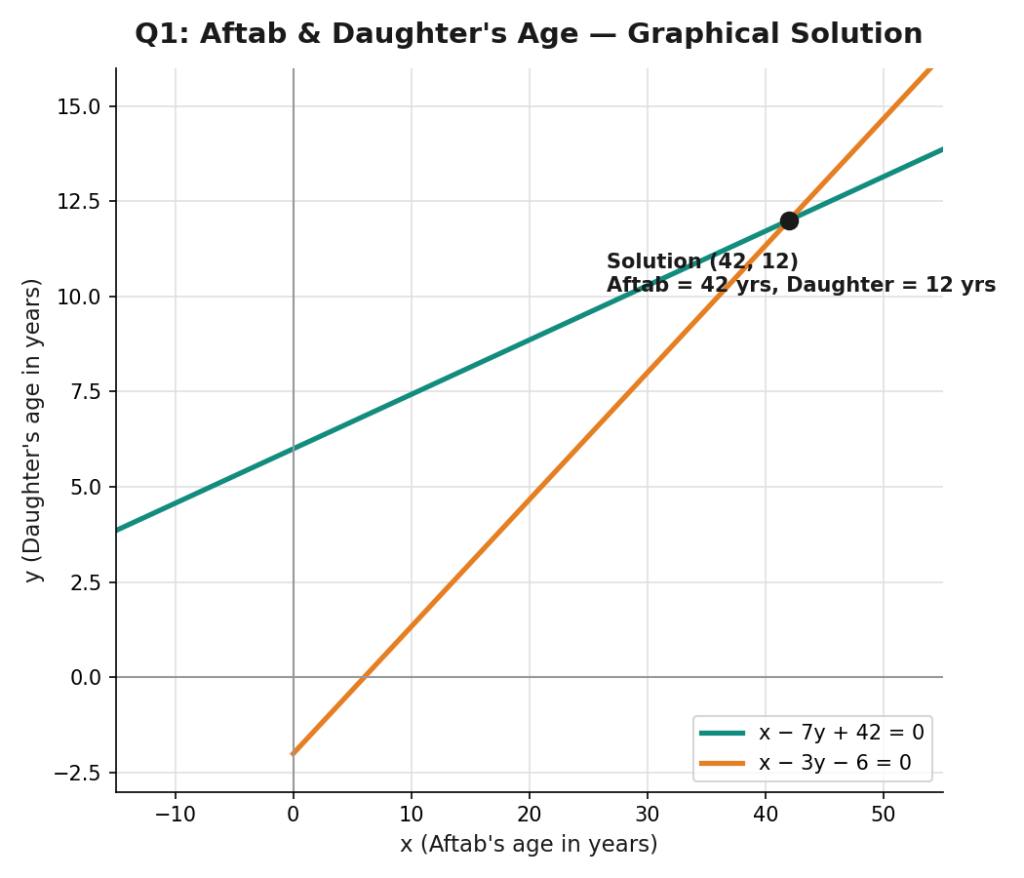
Verification: 7 years ago, Aftab was 35 and daughter was 5 → 35 = 7 × 5 ✓. Three years from now, Aftab will be 45 and daughter will be 15 → 45 = 3 × 15 ✓.
Q2. The coach of a cricket team buys 3 bats and 6 balls for ₹3900. Later, she buys another bat and 3 more balls of the same kind for ₹1300. Represent this situation algebraically and geometrically.
Solution:
Let the cost of one bat = x (in ₹), and the cost of one ball = y (in ₹).
First purchase: 3 bats + 6 balls = ₹3900 3x + 6y = 3900, which simplifies to: x + 2y = 1300 … (Equation 1)
Second purchase: 1 bat + 3 balls = ₹1300 x + 3y = 1300 … (Equation 2)
Solving (for reference): Subtracting Equation 1 from Equation 2: (x + 3y) − (x + 2y) = 1300 − 1300 y = 0
Substituting y = 0 into Equation 1: x = 1300.
So, algebraically, this gives cost of a bat = ₹1300 and cost of a ball = ₹0 — an interesting (if unrealistic-sounding) result that follows purely from the given numbers.
Graphical Representation:
For Equation 1 (x + 2y = 1300):
| y | 0 | 650 | 1300 |
|---|---|---|---|
| x | 1300 | 0 | −1300 |
For Equation 2 (x + 3y = 1300):
| y | 0 | 1300/3 ≈ 433 | 1300 |
|---|---|---|---|
| x | 1300 | 0 | −2600 |
Both lines intersect at the point (1300, 0), confirming the algebraic solution.
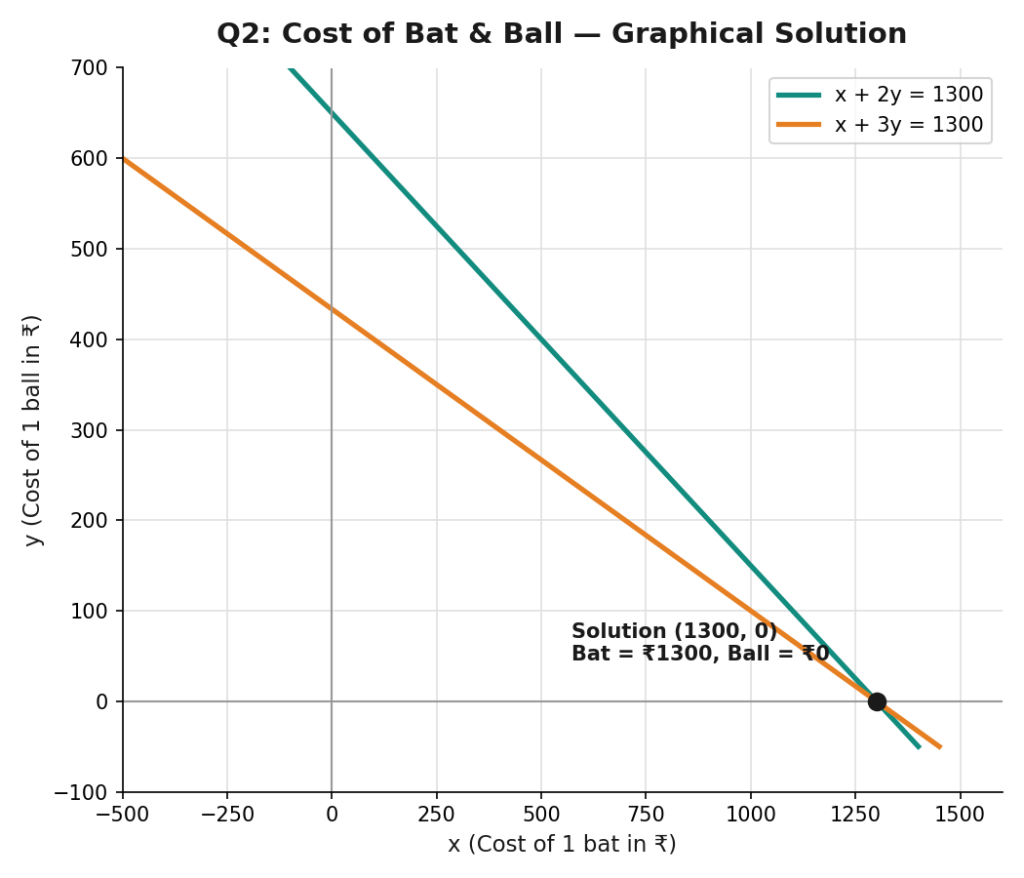
Exam tip (Convex Classes Jaipur): This question is frequently asked only for “algebraic and geometric representation,” not for solving — so in the exam, framing the two equations correctly and drawing the graph carries full marks even without computing the intersection point.
Q3. The cost of 2 kg of apples and 1 kg of grapes on a day was found to be ₹160. After a month, the cost of 4 kg of apples and 2 kg of grapes is ₹300. Represent the situation algebraically and geometrically.
Solution:
Let the cost of 1 kg of apples = x (in ₹), and the cost of 1 kg of grapes = y (in ₹).
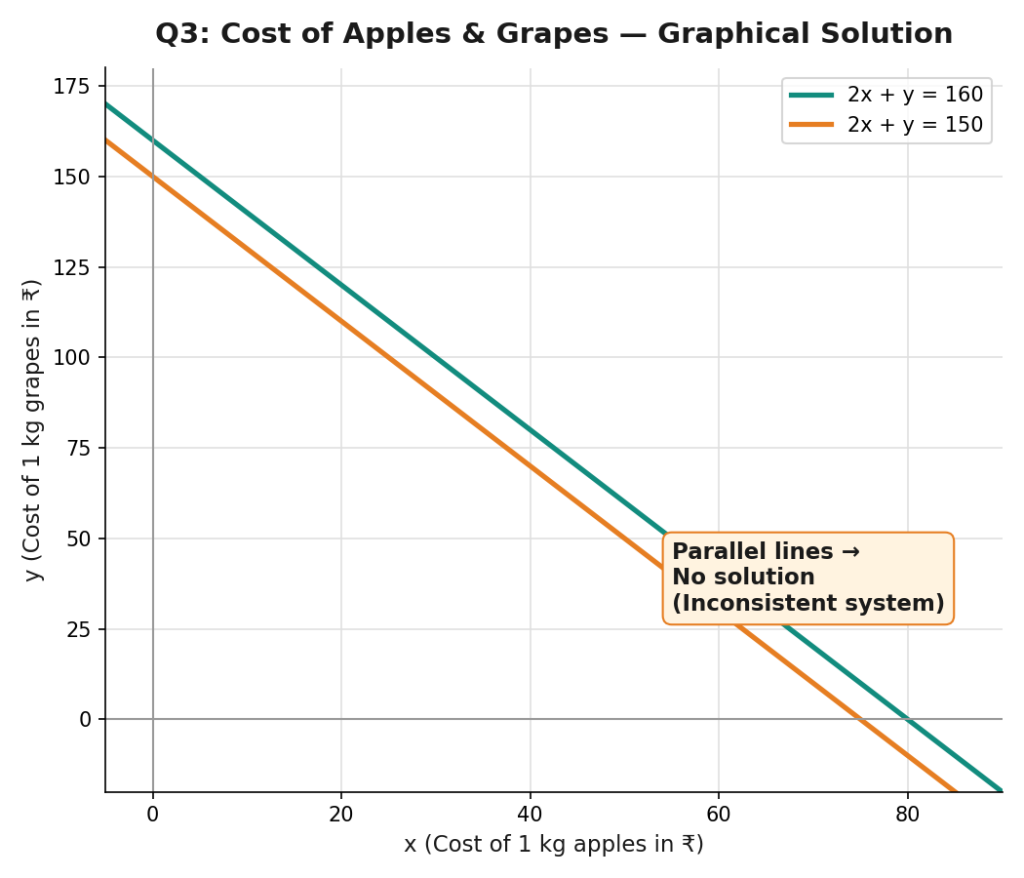
First condition: 2x + y = 160 y = 160 − 2x … (Equation 1)
Second condition: 4x + 2y = 300, which simplifies to: 2x + y = 150 y = 150 − 2x … (Equation 2)
Important observation: Both equations have the same coefficients for x and y (2x + y), but different constant terms (160 and 150). This means:
a₁/a₂ = b₁/b₂ ≠ c₁/c₂
According to the consistency conditions discussed above, this represents an inconsistent pair of equations — the two lines are parallel and never intersect, meaning there is no solution to this system.
Graphical Representation:
For Equation 1 (2x + y = 160):
| x | 0 | 50 | 80 |
|---|---|---|---|
| y | 160 | 60 | 0 |
For Equation 2 (2x + y = 150):
| x | 0 | 50 | 75 |
|---|---|---|---|
| y | 150 | 50 | 0 |
When plotted, both lines will be seen to be parallel to each other, confirming that this situation (as described) has no consistent solution — an important conceptual result that CBSE often tests through this exact question.
Class 10 Maths Chapter 3 – Quick Revision Notes
- Linear equation in two variables: ax + by + c = 0
- Pair of linear equations: two such equations together, representing two lines
- Consistency conditions:
- a₁/a₂ ≠ b₁/b₂ → unique solution (intersecting lines)
- a₁/a₂ = b₁/b₂ = c₁/c₂ → infinitely many solutions (coincident lines)
- a₁/a₂ = b₁/b₂ ≠ c₁/c₂ → no solution (parallel lines)
- Methods of solving: Graphical, Substitution, Elimination, Cross-Multiplication
- Cross-multiplication formula: x/(b₁c₂−b₂c₁) = y/(c₁a₂−c₂a₁) = 1/(a₁b₂−a₂b₁)
- Reducible equations: use substitution like p = 1/x, q = 1/y to convert non-linear-looking equations into a standard linear pair
Frequently Asked Questions (FAQs)
Q1. What are the different methods of solving a pair of linear equations in two variables?
Ans. There are four methods: the graphical method, and three algebraic methods — substitution, elimination, and cross-multiplication. Algebraic methods are generally more accurate for non-integer solutions.
Q2. How do I know if a pair of linear equations has no solution, one solution, or infinite solutions?
Ans. Compare the ratios a₁/a₂, b₁/b₂, and c₁/c₂. If a₁/a₂ ≠ b₁/b₂, there’s a unique solution. If all three ratios are equal, there are infinitely many solutions. If a₁/a₂ = b₁/b₂ but ≠ c₁/c₂, there is no solution.
Q3. Is Chapter 3 Pair of Linear Equations important for CBSE Class 10 board exams?
Ans. Yes, it is one of the most scoring and frequently tested chapters, with word problems and method-based questions appearing almost every year, often worth 3-5 marks each.
Q4. What is the biggest mistake students make in this chapter?
Ans. The most common mistake is framing the equations incorrectly from a word problem — misreading which quantity is “x” and which is “y,” or setting up the relationship between them wrongly. Careful reading and double-checking the equation against the original statement is essential.
Q5. How can Convex Classes Jaipur help me prepare this chapter better?
Ans. At Convex Classes Jaipur, our faculty focus specifically on translating word problems into correct equations, along with speed practice on all three algebraic methods, mock tests, and doubt-clearing sessions aligned with the CBSE marking scheme.
This content has been prepared by the academic team at Convex Classes Jaipur for educational purposes, strictly following the CBSE/NCERT Class 10 Maths syllabus.