
Polynomials are one of the most important chapters in Class 10 Mathematics. They form the building blocks for algebra and help develop critical problem-solving skills for competitive exams like IIT-JEE, NEET, and NDA. This guide is designed to explain every concept related to polynomials in a clear, in-depth, and easy-to-understand manner. Whether you’re a beginner or looking to fine-tune your understanding, this guide will help you master the subject effectively.
What Are Polynomials?
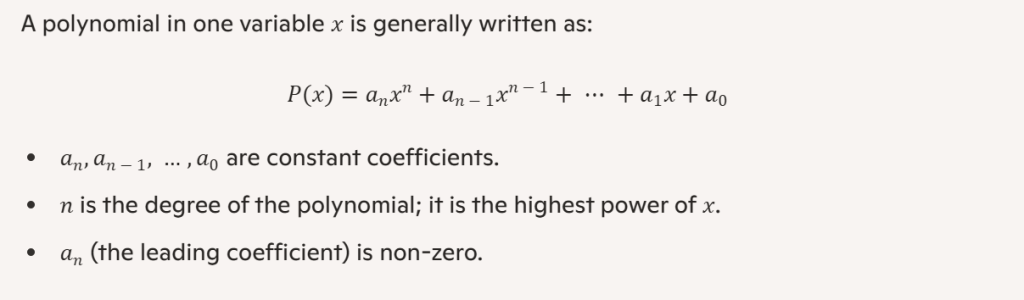
A polynomial is an algebraic expression that consists of variables (like x), coefficients, and non-negative integers that are raised to a power. In simple terms, polynomials are the sum of several terms, and each term can involve multiplication of a number (the coefficient) with a variable raised to an exponent.
Standard Form of a Polynomial
Types of Polynomials: Classification Made Simple
Based on Degree
- Constant Polynomial:
- Definition: A polynomial with no variable part.
- Example: (P(x) = 7) (Degree = 0)
2. Linear Polynomial:
- Definition: Contains the variable raised only to the first power.
- Example: (P(x) = 4x + 6) (Degree = 1)
3. Quadratic Polynomial:
- Definition: Contains the variable up to the power of 2.
- Example: (P(x) = x^2 – 3x + 2) (Degree = 2)
4.Cubic Polynomial:
- Definition: Contains the variable up to the power of 3.
- Example: (P(x) = x^3 + 2x^2 – x + 1) (Degree = 3)
Based on Number of Terms
- Monomial: A single term (e.g., (5x^3)).
- Binomial: Two terms (e.g., (x + 2)).
- Trinomial: Three terms (e.g., (x^2 + 3x + 4)).
Key Formulas to Master Polynomials
Understanding these formulas is crucial for solving polynomial equations and is often tested in Class 10 exams.
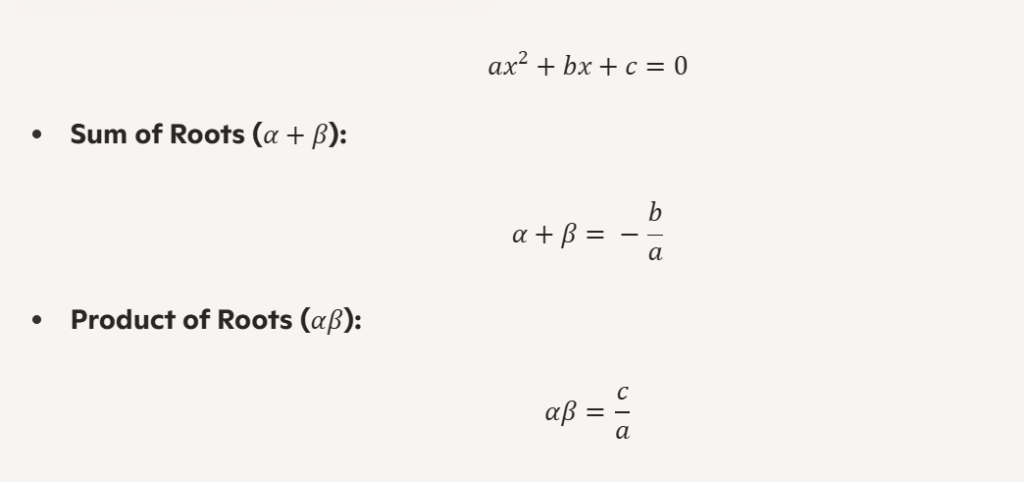
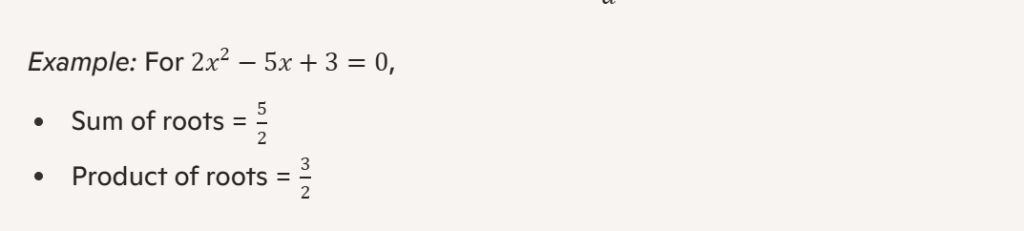
1. Sum and Product of Roots for a Quadratic Polynomial
For a quadratic equation of the form:
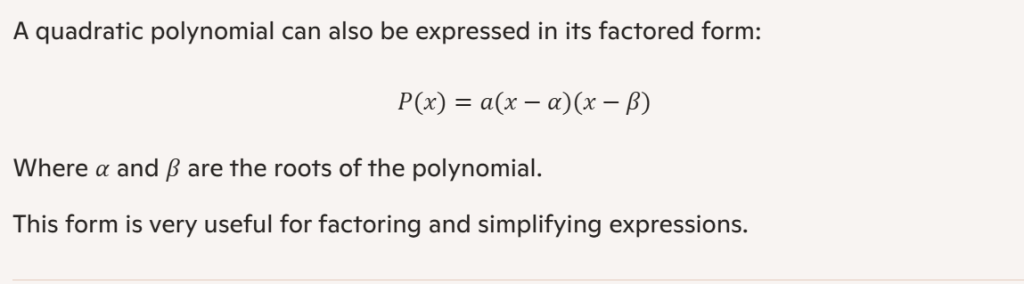
2. Relationship Between Coefficients and Roots
3. Remainder Theorem
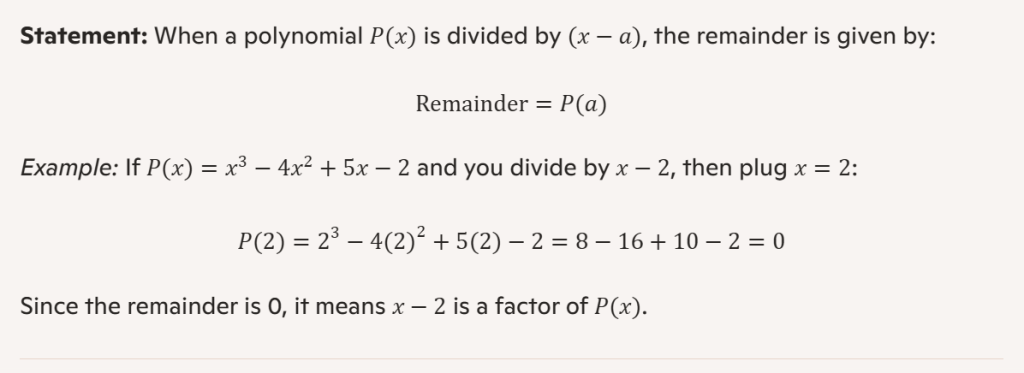
4. Factor Theorem

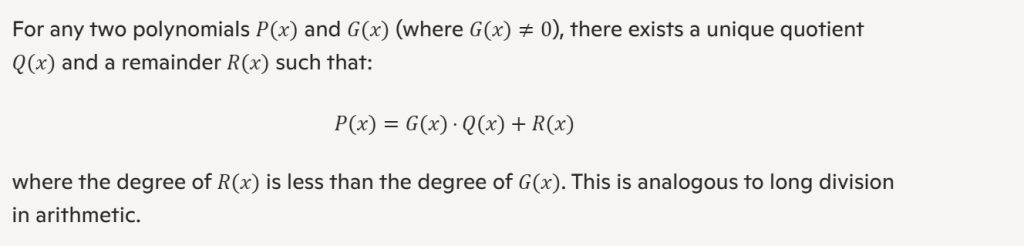
5. Division Algorithm for Polynomials
Graphical Interpretation of Polynomials
Graphs provide visual insight into polynomial behavior. Here are some basic ideas:
- Linear Polynomials:
The graph is a straight line. The coefficient of (x) determines the slope. - Quadratic Polynomials:
The graph forms a parabola. Depending on the sign of (a): - If (a > 0), the parabola opens upward.
- If (a < 0), it opens downward.
- Cubic Polynomials:
The graph typically has an S-like curve with one or two turning points.
Why Graphs Matter:
Visualizing the polynomial helps identify:
- Roots (x-intercepts)
- Y-intercept
- Turning Points
- End Behavior
Graphing calculators or software can be very useful for this purpose.
Tips for Mastering Polynomials
- Understand Concepts Fully:
Know what each term means—don’t just memorize formulas. - Practice Regularly:
Work on problems from your NCERT textbook as well as extra problems provided in competitive exam preparation. - Utilize Visual Tools:
Draw diagrams and graphs to see how changes in coefficients affect the graph of a polynomial. - Work on Factorization Skills:
Practice using the Factor and Remainder Theorems. They are crucial for solving many exam problems. - Revise with Mock Tests:
Regular tests help gauge your understanding and improve speed and accuracy.
Why Choose Convex Classes Jaipur?
At Convex Classes Jaipur, we provide:
- Comprehensive Study Material: Detailed notes, formula sheets, and practice problems to reinforce your learning.
- Personalized Coaching: Tailored guidance to ensure you understand every concept, from basics to advanced applications.
- Regular Assessments: Frequent mock tests and feedback sessions to boost your exam readiness.
- Expert Faculty: Experienced teachers who make learning engaging and simple.
Our goal is to help you master the subject so that you can excel in Class 10 exams and beyond, whether you’re moving towards competitive exams like IIT-JEE, NEET, or NDA.
Conclusion
Polynomials are a vital part of the Class 10 mathematics curriculum and form the basis for many advanced topics in algebra, physics, and engineering. By understanding the definitions, formulas, and graphical representations, you can solve polynomial problems with confidence. Use this comprehensive guide from Convex Classes Jaipur to deepen your understanding and enhance your problem-solving skills. Join us today and unlock your mathematical potential!
FAQs
Q1: What is the standard form of a polynomial?
A1: The standard form is

Q2: How do I find the sum and product of the roots of a quadratic equation?
A2: For

Q3: How do the remainder and factor theorems help in solving polynomials?
A3: The Remainder Theorem states that the remainder of dividing (P(x)) by (x – a) is (P(a)). If (P(a)=0), the Factor Theorem confirms that (x – a) is a factor of (P(x)), simplifying factorization.
Q4: Why are graphical interpretations important?
A4: Graphs help visualize root locations, turning points, and overall behavior, which makes it easier to predict and understand polynomial functions.