Magnetic Effects of Electric Current is a favourite chapter for board exams because it connects theory (field lines, rules) with real devices (motors, generators, household wiring). Below are complete solutions with original diagrams to help you visualize every concept clearly.
📌 Want the full PDF with all diagrams? WhatsApp 8290601516 — Convex Classes provides free notes for Class 10th Science, Maths & English.
📚 Score better in CBSE Class 10th Boards
Get PDF notes + expert coaching for Science, Maths & English — all under one roof at Convex Classes, Jaipur.
WhatsApp Now — 8290601516 (Limited Seats)Magnetic Field and Field Lines
Q1. Why does a compass needle get deflected when brought near a bar magnet?
Answer: A compass needle is itself a tiny magnet. When it enters the magnetic field of a bar magnet, the field exerts a force on the needle’s poles, causing it to rotate and align itself along the direction of the field at that point. The amount of deflection tells us how strong the field is at that location.
Q2. Draw magnetic field lines around a bar magnet, and list their key properties.
Answer: Field lines emerge from the north pole, curve around the magnet, and re-enter at the south pole, forming closed loops (they continue inside the magnet too, from S to N).
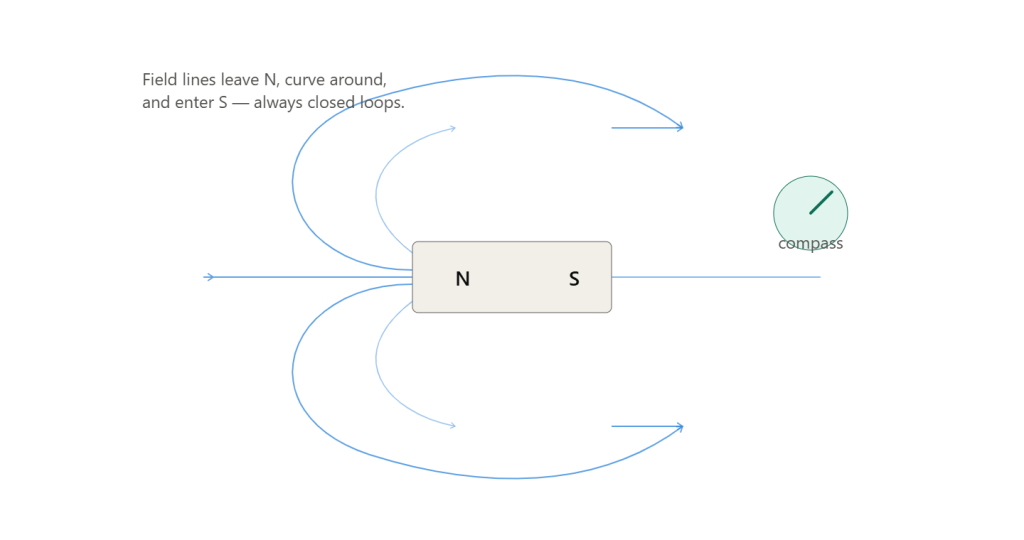
Key properties of magnetic field lines:
- They start at the north pole and end at the south pole (outside the magnet).
- They form closed loops — inside the magnet, they run from S back to N.
- The field is strongest where the lines are closest together (near the poles).
- No two field lines ever cross — at any point, the field has only one direction, so crossing would mean two directions at once, which isn’t possible.
Magnetic Field Due to a Current-Carrying Conductor
Q3. State the right-hand thumb rule. What does it tell us about the field around a straight current-carrying wire?
Answer: If you hold a straight current-carrying conductor in your right hand such that the thumb points in the direction of current flow, the direction in which your fingers curl gives the direction of the magnetic field lines around the wire. These field lines are concentric circles around the wire, in a plane perpendicular to it — the closer to the wire, the stronger the field.
Q4. How does the magnetic field of a solenoid compare to that of a bar magnet?
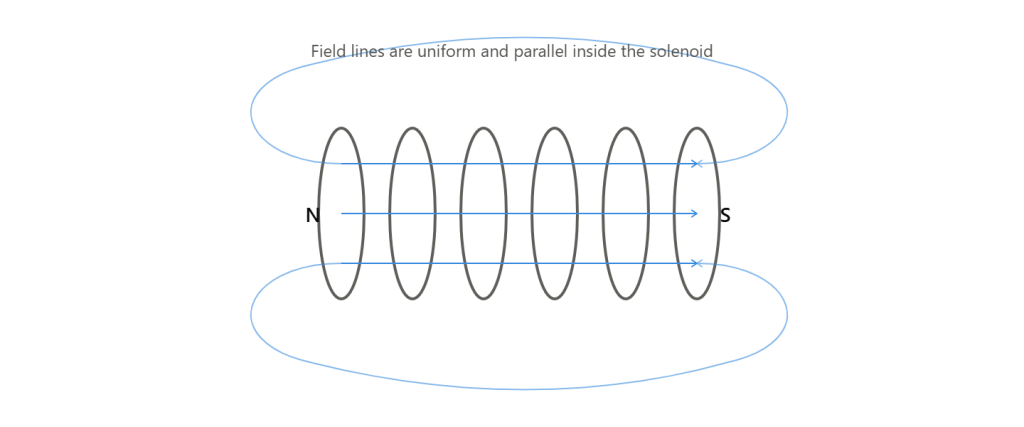
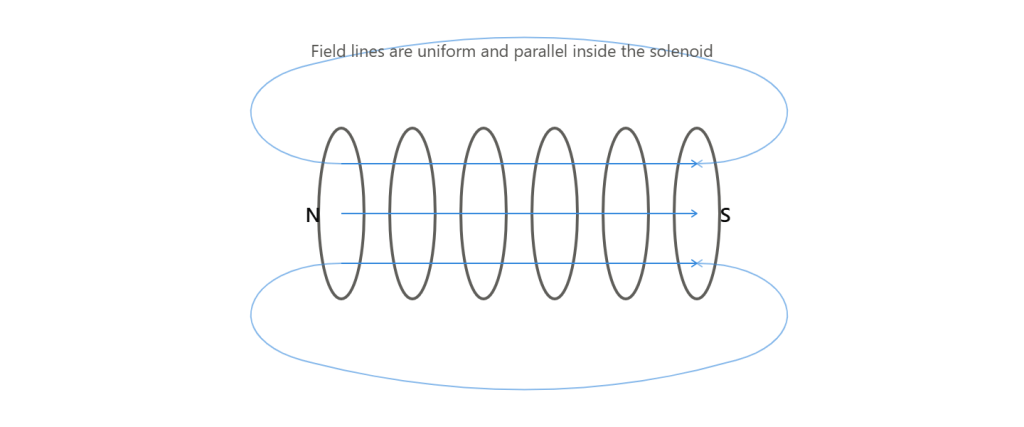
Answer: A solenoid is a coil of many circular turns of insulated wire. When current flows through it, the field lines from each turn add up, and the overall pattern outside and inside the solenoid closely resembles that of a bar magnet — one end behaves like a north pole and the other like a south pole. Inside the solenoid, the field lines are parallel and equally spaced, showing the field is uniform there.
Here’s what that current-carrying coil looks like from the inside:
One more useful application: solenoids are used to make electromagnets by inserting a soft iron core inside — this greatly increases the strength of the magnetic field, and it’s the working principle behind devices like electric bells, cranes that lift scrap iron, and circuit breakers.
Force on a Current-Carrying Conductor (Fleming’s Left-Hand Rule)
Q5. When is the force on a current-carrying conductor placed in a magnetic field the largest? State Fleming’s left-hand rule.
Answer: The force is maximum when the direction of current in the conductor is perpendicular to the direction of the magnetic field. If the current is parallel to the field, the force becomes zero.
Fleming’s left-hand rule: Stretch the thumb, forefinger, and middle finger of your left hand so that they’re mutually perpendicular to each other.
- The forefinger points in the direction of the magnetic field.
- The middle finger points in the direction of the current.
- The thumb then gives the direction of the force (motion) on the conductor.
This rule is the working principle behind an electric motor.
Electric Motor
Q6. Draw a labelled diagram of a simple electric motor and explain its working. What is the function of the split ring (commutator)?
Answer: An electric motor converts electrical energy into mechanical energy, using the force experienced by a current-carrying coil placed in a magnetic field.
Working: When current flows through the coil ABCD placed between the poles of a magnet, side AB and side CD experience forces in opposite directions (by Fleming’s left-hand rule), since current flows in opposite directions through them. These two forces form a couple that rotates the coil.
Function of the split-ring commutator: As the coil completes half a rotation, the sides AB and CD swap positions (AB moves to where CD was). If the current direction through the coil didn’t reverse at this point, the coil would experience a force that stops it rather than keeps it turning. The split-ring commutator automatically reverses the direction of current in the coil every half rotation, so the force continues to act in the same rotational direction — keeping the motor spinning continuously.
Q7. Name some devices in which electric motors are used.
Answer: Electric fans, washing machines, mixer-grinders, refrigerators, water pumps, electric vehicles, and many toys.
🎯 Preparing for CBSE Class 10th Boards?
Convex Classes, Jaipur offers expert coaching for Science, Maths & English with structured notes, doubt-solving, and exam-focused practice.
WhatsApp 8290601516 for a Demo ClassElectromagnetic Induction
Q8. A coil of insulated copper wire is connected to a galvanometer. What happens if a bar magnet is (i) pushed into the coil, (ii) withdrawn from the coil, (iii) held stationary inside the coil?
Answer:
(i) Pushed in: The galvanometer needle deflects momentarily in one direction, showing an induced current — because the magnetic flux through the coil is changing (increasing).
(ii) Withdrawn: The needle deflects in the opposite direction, since the flux is now decreasing.
(iii) Held stationary: There is no deflection — since the flux through the coil is not changing, no current is induced.
This shows that current is induced only when there’s a change in magnetic flux — this is the principle of electromagnetic induction.
Q9. Two circular coils A and B are placed close together. If the current in coil A is changed, will current be induced in coil B? Why?
Answer: Yes. As the current in coil A changes, the magnetic field (and hence the flux) around it also changes. Since coil B lies within this changing field, the changing flux through coil B induces a current in it — even though the two coils are not physically connected.
Q10. State Fleming’s right-hand rule.
Answer: Stretch the thumb, forefinger, and middle finger of your right hand mutually perpendicular to each other.
- The forefinger points in the direction of the magnetic field.
- The thumb points in the direction of motion of the conductor.
- The middle finger then gives the direction of the induced current.
This is the working principle of an electric generator — the opposite of Fleming’s left-hand rule used for motors.
Q11. State the principle of an electric generator. What is the essential difference between an AC and a DC generator?
Answer: An electric generator works on the principle of electromagnetic induction — when a coil is rotated in a magnetic field, the flux through it keeps changing, inducing a current in the coil.
The essential difference: an AC generator uses slip rings to connect the rotating coil to the external circuit, which allows the current direction to reverse every half rotation (producing alternating current). A DC generator uses a split-ring commutator instead, which reverses the connections at the same moment the current in the coil reverses, so the output always flows in one direction (direct current).
Q12. If the AC supply frequency is 50 Hz, how many times does the current change direction in one second?
Answer: In one complete cycle, the current changes direction twice. So at 50 Hz, the current reverses direction 100 times per second.
📚 Score better in CBSE Class 10th Boards
Get PDF notes + expert coaching for Science, Maths & English — all under one roof at Convex Classes, Jaipur.
WhatsApp Now — 8290601516 (Limited Seats)Domestic Electric Circuits
Q13. What are the three wires used in domestic electric circuits, and what is each for?
Answer:
- Live wire (red insulation): Carries current from the power supply into the house; it is at high potential.
- Neutral wire (black insulation): Completes the circuit back to the source; normally at zero potential.
- Earth wire (green insulation): Connects the metal casing of appliances to the earth, providing a safe path for current in case of a leakage — protecting users from electric shock.
Q14. Why is it necessary to earth metallic appliances?
Answer: If a fault causes the live wire to touch the metal body of an appliance, and the appliance is earthed, the leaked current flows safely into the earth through the low-resistance earth wire instead of through a person who touches it. This prevents electric shocks.
Q15. What is a fuse, and why is it used in electric circuits?
Answer: A fuse is a short length of wire made of a metal (or alloy) with a low melting point, connected in series in a circuit. If the current exceeds a safe value — due to a short circuit or overloading — the fuse wire heats up and melts, breaking the circuit before it can damage appliances or cause a fire.
Q16. What precautions should be taken to avoid overloading of domestic circuits?
Answer:
- Avoid connecting too many high-power appliances to a single socket or circuit at the same time.
- Use appropriately rated fuses/MCBs for each circuit.
- Avoid using too many extension cords or “octopus” connections from a single plug point.
- Don’t use damaged wires or plugs.
Quick Revision Table
| Rule | Used for | Direction gives |
|---|---|---|
| Right-hand thumb rule | Field around a straight wire | Direction of magnetic field |
| Fleming’s left-hand rule | Motor (force on current in a field) | Direction of force/motion |
| Fleming’s right-hand rule | Generator (induced current) | Direction of induced current |
📚 Need more chapter-wise NCERT solutions with diagrams? Convex Classes, Jaipur provides complete notes and expert doubt-solving for CBSE Class 10th Science, Maths & English.
WhatsApp 8290601516 for PDF notes and demo class details.